Showing posts with label Labour party. Show all posts

Thursday, 20 January 2011

Ed Balls now has Miliband in the palm of his hand

I haven't really got time for this, but...

The Alan Johnson resignation this afternoon came as a shock.  The affable former postman might have taken to his new brief like a duck to a shooting range, and he wasn't joking about needing an economics primer, however who genuinely saw this coming?

The embarrassing gaffes have not helped.  Not only have they damaged Labour presentationally, they have wounded a good man's pride.  No one enjoys being ridiculed, especially about their maths gremlins.  And honestly, as much as I like Johnson, telling a BBC journalist that they "probably read more" of the last Labour budget is a self-deprecation too far for a Shadow Chancellor.

But strategically, Johnson was still useful for Ed Miliband.  I wrote in October that the choice of Johnson was "strikingly astute" as it tied up a critical colleague and reassured the public that Labour would pursue a credible economic policy by backing Alistair Darling's deficit reduction plans.

The alternative - Ed Balls - had long advocated a softer policy that would put further investment, growth and recovery ahead of deficit reduction and higher taxes for the rich to mitigate spending cuts.  When it came to the decision, Miliband rightly acknowledged reality and plumped for Johnson, sending Balls off to shadow Theresa May.

Since then, however, Labour's economic message, driven by Miliband and Johnson, has been a 'me-too' muddle: opposing some cuts but broadly agreeing that the deficit had to be addressed.  Miliband's leadership has never got off the ground, paternity leave or not.

Meanwhile, Ed Balls has been in combative mood, impressing as shadow home secretary, most recently in portraying the Government's hokey-cokey dance over Control Orders as playing party politics with national security.

He has also not been keeping his dissatisfaction with the Labour leadership's economic policy to himself.  As early as the CSR you could tell he was fuming inside as he watched Alan Johnson stand up to deliver a happy-go-lucky slapstick routine when Balls' well-reviewed Bloomberg speech would have been more effective, to put it lightly.

As wicked irony would have it, had Ed Miliband appointed Ed Balls as his Shadow Chancellor back in October, the new leader would probably have been able to command a certain amount of authority over his defeated challenger.

Now, however, Balls is in the ascendency and in spite of a good victory in Oldham last week, Miliband is struggling.  Personal dynamics are also important.  When Gordon Brown was Chancellor, Balls was his right-hand man (apparently unable to make decisions without consulting him) whereas Miliband was a junior adviser.   On economic policy (at the very least) it will be Balls, not his leader, who will be running the show.

The Government can use this to its advantage if it can successfully paint Ed Balls as the man who, along with Gordon Brown, got the country into its present mess.  If the spinners can manage to depict Miliband as the 'son of Brown', Balls is a much more obvious target.

Yet allow Balls to gain even an inch and he'll take not one yard but ten.  Say what you like about him - he is a consummate political operator.  His first task is likely to be to attack the Government over inflation and VAT - on both counts he can turn his involvement in the last Labour Government to his advantage.  Back then, he and Brown presided over the NICE decade - the Governor of the Bank of England wasn't writing many letters to the Chancellor in those years.  There are myriad reasons why the analogy is inadequate but that never stopped a good soundbite.

And VAT, which is contributing to rising inflation and crucially inflationary expectations, is a topic on which Ed Balls actually has some credibility.  It was Balls who, before the last General Election, insisted that Labour must pledge not to raise VAT.  He was correctly and honourably overruled by Alistair Darling.

Now that Balls is calling the shots, he can tell us all that he was right all along.  Don't increase the regressive VAT, which hurts ordinary hard-working British families - put up taxes on the rich instead.

I sometimes hear Conservative backbenchers confiding that the man pulling the strings in Government is George Osborne.  Now his opposite number will be doing the same for Labour.  And like Osborne, Balls is a scheming politician to the bones: they are always sniffing around for dividing lines.

However it all pans out, you can count on something.  The Chancellor can say goodbye to relaxing skiing trips to Klosters.  With Ed Balls conducting the Opposition's orchestra, he'll be lucky if he gets a spare weekend.

Wednesday, 1 December 2010

Dear Scottish MPs, mind your own parliamentary business

Yesterday was the feast day of St Andrew, the patron saint of Scotland.  I sincerely hope that all people in Scotland had an enjoyable Latha Naomh Anndra and that the whisky burn at the back of the throat has disappeared by this evening.  I find that ibuprofen, rather than paracetamol, tends to be better at easing the consequences of that particular tipple.

Something else than the Scottish fire-water gave me a headache last night - something that no over-the-counter painkiller can subdue.  What was it?  Scottish MPs.  Why?  Their insistent bleating about Government reforms to higher education that have nothing to do with them.

A devolved matter, the Scottish Parliament voted in 2000 to abolish tuition fees for all Scottish, Welsh, Northern Irish and European Union students - just about everyone apart from English students.  That was their choice to do so and residents of Scotland have to make do with budget restraints in other areas.

The upcoming reforms to higher education in England and Wales do not, therefore, concern the constituents of the honourable Members from North Britain.  Why, then, did a series of them bob up and down in the House of Commons last night in search of a say in the Opposition debate on higher education?  And to the loss of other honourable Members whose constituents will actually be affected by the reforms?

Pamela Nash MP, 'Baby of the House'
Ian Murray (Lab, Edinburgh South) failed in his efforts to get the Secretary of State, Vince Cable, to give way, but it was not long afterwards that Fiona O'Donnell (Lab, East Lothian) was up on her feet to whinge about Lib-Dem members putting out leaflets in the snow.  Then Pamela Nash (Lab, Airdrie & Shotts) interrupted Iain Stewart (C, Milton Keynes South) with the claim that the Government is introducing its reforms based on ideology.  I don't think that the Baby of the House (Ms Nash is 26) is so young that she cannot recall that the Government is acting on the advice of an independent report commissioned by the preivous Labour Government.  Moreover, as a recent politics graduate of the University of Glasgow, she has (unlike me and my peers from English universities) never had to pay tuition fees, but was happy to work as Lord (John) Reid's researcher when he was a long-serving member of the Labour Government that increased fees twice against manifesto promises.

Some moments later, Peter Wishart (SNP, Perth & North Perthshire) spat out a party political broadcast on behalf of his virtuous, caring and competent party colleagues prior to making the bewildering claim that, "these pernicious fees will have a significant impact on Scottish higher education...[and] disastrous consequences for our universities."  What are these consequences?
"English universities will be awash with tuition fees [so] we will be at a competitive disadvantage.  The fact that we will not have the same development and resources to provide research facilities to attract international students could have disastrous consequences."
My retort is too obvious to mention (guesses as to my solution to Mr Wishart's dilemma on the back of a postcard).

Anas Sarwar (Lab, Glasgow Central) followed less than ten minutes later.  To his credit, he scathingly referred to the above "rather delusional performance from the hon. Member for Perth and North Perthshire" and decided to focus on the more debatable necessity of the 80 per cent cuts to teaching grants.  Yet Mr Sarwar referred to the "thousands of students, school pupils, teaching staff and parents" that the reforms will affect and "our young people".  Not your young people, sir, for they remain un-affected.  Like your father's former Glasgow constituent, the aforementioned Pamela Nash MP, they don't have to pay tuition fees at all.

The West Lothian Question is not a constitutional quirk that has ever excited me.  'English votes for English laws', an 'English Parliament', or other apparent solutions, pose far too great a threat to the future solidarity and existence of the Union.  Like the inherent electoral bias of constituency size enjoyed by the Labour Party, I've always seen the West Lothian issue as a Question not worth an Answer.

Yet on this issue of tuition fees, for historical reasons, I make an exception.  For it was the voting support of Scottish MPs in January 2004 that enabled the Tony Blair to pass the Higher Education Bill by the slender margin of 316-311, and thus introduce university top-up fees of £3,000.  Labour's Scottish MPs were described at the time as "reprehensible", "constitutionally cavalier" and "Tony's Tartan lobby fodder".  In stark contrast, the lone 'Tartan Tory', Peter Duncan (former MP for Galloway & Upper Nithsdale), had the dignity to ignore his party whip and abstain.

I have since come to accept the necessity of tuition fees but I, like Conservative MPs and the wording of Labour's 1997 and 2001 manifestos, opposed their introduction at the time.  In 2004, English MPs (of all parties) and the English public were overwhelmingly against them but they got through because of Scottish Labour MPs whose constituents were unaffected.  And now, Scottish MPs have the gall to stand up in Parliament and oppose their further increase, at a time of tentative economic recovery and the nation's finances in a mess (their mess, no less), having voted to increase fees when the economy was booming.

This time, unlike in 2004, the votes and speeches of Scottish MPs should not derail the democratic prerogative of the English MPs whose constituents these reforms affect, and affect alone.  Even if most Liberal Democrat MPs abstain on the vote, it shall pass.

In 2004, the involvement of Scottish Labour MPs was a constitutional scandal.  Thankfully, today it is merely a bloody cheek.

Monday, 15 November 2010

Needless slaughter awaits if Conservatives can't get on message

Nearly two months ago, Michael Fallon became deputy chairman of the Conservative Party.  The appointment was greeted warmly by the likes of Benedict Brogan ("a smart appointment" of "an adept media performer") and Tim Montgomerie ("the thinking man's rottweiler") as a sign that the senior party in Government was sharpening up its communications strategy after what Paul Goodman described as a summer of "no effective counter-attack" to "the Labour and media assault on the Government."

Goodman, the former Conservative MP for Wycombe, said that the Government's cull of special advisers had "blunted its political edge".  The Coalition needed a simple message to counter the Labour opposition's crass but straightforward "Tory cuts" line.  This message must be communicated relentlessly through the media.  Crucially, the party needed "to find and unleash attack dogs."  Enter Michael Fallon, who Brogan nominated as "Minister for the Today Programme".

And the former MP for Darlington (I declare no interest) has made a steady - if inobtrusive - start.  Last Thursday, Fallon tore into shadow chancellor Alan Johnson's fallacious assertion that the Labour Government was "never living beyond our means."  As a member of the Treasury Select Committee between 1999 and 2010, Fallon knows keenly how deluded a statement this is.  He rightly declared it "as hollow as Gordon Brown's claim to have 'ended boom and bust'."

Then yesterday, Fallon picked up on the massive policy gulf between Mr Johnson and his leader, Ed Miliband on the 50p income tax rate and university funding.  Johnson, as the Labour minister who introduced tuition fees, is against a graduate tax, and on Sunday's Politics Show he admitted that his party had yet to agree on a "considered policy" on the top rate of tax.  Miliband wants to make it permanent but his shadow chancellor has said otherwise.

Michael Fallon said, "It's an extraordinary admission... Seven weeks after he was chosen, Ed Miliband still can't make up his mind - there's still no Plan A."

In two statements, Fallon is transmitting two simple political messages: 1) Remind the public of the hubristic hash that was Labour's economic mismanagement, and 2) Highlight the sclerotic, rudderless inertia and incertitude that is Labour in opposition - personified by the cleavage between Ed Miliband and Alan Johnson.

The Conservative Party needs a coherent, attacking message centred on these themes.  At the same time, reminding people that what the Government is doing is a good thing.  Tim Montgomerie writes today on Conservative Home, a right-wing political website, that David Cameron needs to make a quartet of political appointments to the Downing Street machine in order to address its weakness of message and capacity to drift.

Whilst I am a bit sceptical of Mr Montgomerie's motives in singling out specific names for specific jobs (maybe he is implicitly recommending a fifth position - himself, as No 10's HR manager), the point he makes is an important one.  The Prime Minister surrounds himself with people "he's comfortable with" and as a result "few people say uncomfortable things to him."  There is a genuine danger that too much of the Hilton-esque Big Society narrative - while it is sound and relevant (see Chris Butt on ConHome), it is terrible branding - is going straight over people's heads.  Conversely, the asinine but uncomplicated anti-cuts message from Labour is registering with the public (as recent opinion polls would suggest).

Someone does need to be ramming the message home that the cuts are not as bad as ideologically myopic elements of the media proclaim, and nor does the Labour Party have a credible alternative - or, for that matter, credibility.

If the Prime Minister has salaried space for an official photographer then I'm sure that he is able to find room for the sort of positions that Montgomerie has adumbrated.  Yet if you allow me to be uncharacteristically partisan for a brief moment, David Cameron remains head of a coalition government, transmitting a coalition message, from a coalition platform.  That was a mistake made in the summer in the form of Baroness Warsi and Chris Huhne's joint party-political press conference.

There needs to be a distinctive Conservative Party voice and the deputy chairman, Michael Fallon, should be it, and he should be heard louder and more frequently.  This is not a call to arms for a war of New Labour subterfuge and spin.  This is simply ensuring that the British public understand why this (Conservative led) Government is doing what it is doing.

Even in doing so, the party is bound to suffer to some extent in the provincial and local elections next May.  If the party fails to make this case, the suffering will become a slaughter.

Thursday, 11 November 2010

Labour broke a tuition fees pledge too but Government still isn't making its case

The Deputy Prime Minister, Nick Clegg, faced a torrid time at PMQs yesterday as question (or should I say attack?) after question centred on tuition fees and higher education.
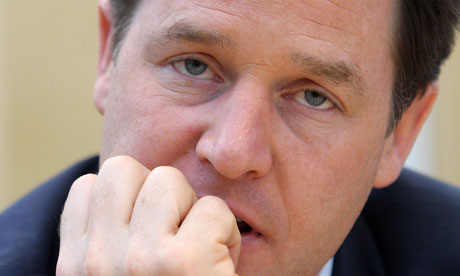
This is intensely difficult for all Liberal Democrat MPs, not least their leader, and the strain showed in his face.  His voice was hoarse with frustration and emotion as the half-hour trial neared its end.
That Labour introduced tuition fees against their own manifesto promise is something that the Government needs to remind people of, and Clegg mentioned this yesterday.  The Labour Party manifesto in 2001 contained the following promise:
"We will not introduce 'top-up' fees and have legislated to prevent them."
This is a point worth reiterating, yet only so far.  It was a long time ago now (most of the students protesting yesterday were still at primary school when that promise was made) and it does not make those photos of smiling Lib-Dem MPs holding NUS pledge placards disappear. There needs to be a better argument made about why the Government's plans for higher education are economically necessary and - I'm going to use two words I can't stand, sorry - fair and progressive.
The Government needs to be incorporating HE policy within its wider education programme, something I wrote about when Lord Browne published his review last month and again following David Willetts' statement to the House of Commons on 2nd November. The universities and skills minister did make the point that the HE reforms sit alongside other education reforms, such as the pupil premium and free schools.  Higher standards of assessment should also be added to that list.  But little has been heard of this line of argument since.  One senior source on the Liberal Democrat benches tells me that the Government needs to put this point across, as better schooling is vital to widening access to higher education.

Martin Horwood - as courageous as he was being the only Lib Dem MP to come out and face the music yesterday afternoon - didn't help the cause by responding to a bolshy student, "do you think the fairies are going to pay for your education?"
The argument that binmen and bricklayers shouldn't be paying their taxes to subsidise the education of university students has run its course.  The considerable value of a highly educated, graduate population is now self-evident, not least in that the UK's economic future lies in expert service industries and high technology.  Moreover, it is estimated that the UK's higher education's economic impact is in excess of £45 billion and the sector supports over 600,000 jobs.
So the Government must make the this argument and it must make it frequently: education is not a zero-sum game and universities are not an isolated part of the education system.   Reforms to higher education do not, on the face of it, appear to be good news but there is plenty of excellent material lying behind the fees increase, such as support for part-time students and reduced repayment costs for many as a result of the increased threshold.  There are many other positive reforms taking place in education as a whole, and the necessary reforms to higher education must be considered as one part of that longer, formative stage in  young people's lives.