Showing posts with label Lord Browne. Show all posts

Wednesday, 24 November 2010

What is the real motive of "irresponsible" Goldsmiths university lecturers?

Eyebrows were raised when, following the violent student protests on 10th November, lecturers at Goldsmiths, University of London, praised the "magnificent" rioters.  10 Downing Street condemned the lecturers' "irresponsible" comments.

This was, after all, the occasion of injured police officers and more than sixty arrests of protesters.  The occasion that the inner lobby of 30 Millbank was gutted, dismembered and defaced.  The occasion of a jejune lust for wreckage; masquerading as a peaceful, bona fide demonstration.

Yet these coarse academics felt obliged to praise the unlawful mayhem.  And, it occurred to me, why not?  When you begin to appreciate their actual motive, it makes perfect marketing sense.

Some brief background, if I may.  Universities in this country, up until now, have existed behind a cosy, protective, state-sponsored screen of unaccountable torpescence.  We have maintained this farce that each and every degree classification is accurate and equal.  A 2:1 from Durham University is tantamount to a 2:1 from the University of Bedfordshire, for instance.  Of course, we all know this to be bogus, but universities can still hide the mediocrity of their actual performance and standing behind the veil of uniformity that shields the sector.  For the ideologically imposed reasons of 'equality', one eminently more valuable degree course is not permitted to signal its higher worth in the marketplace through the price mechanism.

Until now.  The Government have not accepted Lord Browne's headline proposal to remove the undergraduate tuition fees cap; however, the revised policy of a lower cap of £6,000 and a higher cap of £9,000 leaves institutions plenty of room for manoeuvre, as robust pricing research has shown.

When former colleagues and I questioned leading university executives prior to the general election, the majority (70%) expected fees to be capped at a level above £6,000, with £7,000 being the most commonly selected.  For an open market to emerge, the highest proportion of respondents suggested the £7,000-£8,000 range.  When asked about optimal levels for their own institutions, there was a clear preference for fees below £7,000.  Pre-1992 universities were most comfortable with higher fees but by contrast, all but one of the post-1992 respondents considered a level up to £5,000 or £6,000 as optimal.  They know their market, and they know it won't bear fees of £9,000.

So what is my point?  Goldsmiths are worried about the new undergraduate fees scenario.  No, they are not a former poly, or post-1992 institution.  Goldsmiths College was founded at the end of the 19th century.  It has heritage and pedigree.  It is a member of the 1994 Group, the coalition of top smaller research-intensive universities.  Nonetheless, its actual performance puts it in a middling position.  The Guardian's 2011 university guide ranks Goldsmiths at 58th (down from 39th in 2010), below the likes of Huddersfield, Nottingham Trent and Chichester.  Some of its research and core capabilities in the arts are ranked very highly.

Goldsmiths represents, in the higher education sector, the "squeezed middle".  The difficulty faced by the likes of Goldsmiths is twofold: (i) It is plainly not good enough to charge as much as the country's best universities; but (ii) it is plainly not bad enough so have a budget price tag and get by on volume.

A high price tag transmits a signal of quality.  A low one, the opposite.  Goldsmiths aspires to greatness, and in some areas it could achieve it, but at the moment, its reputation and, to be frank, performance, does not justify the price tags of greatness.

An open market in tuition fees threatens to expose inadequacies in our higher education sector.  It is the middling universities, neither rubbish nor brilliant, who have the most difficult task in differentiating themselves from the competition.  They will have to think of smart, innovate marketing strategies to win students in this harsh new world.  They can do this in several ways and, from my experience working in the sector, I know that several university marketing departments are coming round to thinking in this way, some brilliantly so.

The fascinating and vital trait that keeps being born out in studies of this sector (as most others, of course) is brand recognition.  That intangible, ethereal, frustratingly qualitative quantity: brand.  Get your name out there, and get it known.  For something, anything, but make it distinctive.

The reaction of some firebrand Goldsmiths lecturers after the 10th November student riots was irresponsible and rightly condemned by the Government and university authorities.  But it has made you talk about Goldsmiths.

*As my long-standing readership will know, I am not an uncritical observer of market forces in higher education.  My viewpoint here is to provide a rationale for the irrational stance of certain Goldsmiths lecturers, not to say that marketisation of higher education is a good thing.  It isn't totally.  But it is here to stay, and universities will have to adapt to that.

Thursday, 11 November 2010

Labour broke a tuition fees pledge too but Government still isn't making its case

The Deputy Prime Minister, Nick Clegg, faced a torrid time at PMQs yesterday as question (or should I say attack?) after question centred on tuition fees and higher education.
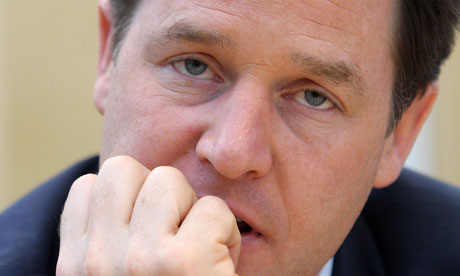
This is intensely difficult for all Liberal Democrat MPs, not least their leader, and the strain showed in his face.  His voice was hoarse with frustration and emotion as the half-hour trial neared its end.
That Labour introduced tuition fees against their own manifesto promise is something that the Government needs to remind people of, and Clegg mentioned this yesterday.  The Labour Party manifesto in 2001 contained the following promise:
"We will not introduce 'top-up' fees and have legislated to prevent them."
This is a point worth reiterating, yet only so far.  It was a long time ago now (most of the students protesting yesterday were still at primary school when that promise was made) and it does not make those photos of smiling Lib-Dem MPs holding NUS pledge placards disappear. There needs to be a better argument made about why the Government's plans for higher education are economically necessary and - I'm going to use two words I can't stand, sorry - fair and progressive.
The Government needs to be incorporating HE policy within its wider education programme, something I wrote about when Lord Browne published his review last month and again following David Willetts' statement to the House of Commons on 2nd November. The universities and skills minister did make the point that the HE reforms sit alongside other education reforms, such as the pupil premium and free schools.  Higher standards of assessment should also be added to that list.  But little has been heard of this line of argument since.  One senior source on the Liberal Democrat benches tells me that the Government needs to put this point across, as better schooling is vital to widening access to higher education.

Martin Horwood - as courageous as he was being the only Lib Dem MP to come out and face the music yesterday afternoon - didn't help the cause by responding to a bolshy student, "do you think the fairies are going to pay for your education?"
The argument that binmen and bricklayers shouldn't be paying their taxes to subsidise the education of university students has run its course.  The considerable value of a highly educated, graduate population is now self-evident, not least in that the UK's economic future lies in expert service industries and high technology.  Moreover, it is estimated that the UK's higher education's economic impact is in excess of £45 billion and the sector supports over 600,000 jobs.
So the Government must make the this argument and it must make it frequently: education is not a zero-sum game and universities are not an isolated part of the education system.   Reforms to higher education do not, on the face of it, appear to be good news but there is plenty of excellent material lying behind the fees increase, such as support for part-time students and reduced repayment costs for many as a result of the increased threshold.  There are many other positive reforms taking place in education as a whole, and the necessary reforms to higher education must be considered as one part of that longer, formative stage in  young people's lives.

Wednesday, 3 November 2010

Mr Willetts was listening - you can't separate universities from schools

The universities and science minister, David Willetts, set out this afternoon before the House of Commons, the Government's final response to Lord Browne's independent review of student finance and funding.  I say "final" with some caution because if there is significant time given over to parliamentary debate and, more importantly, any Commons votes, on the matter, don't bet against it being altered in some ways still.

Nevertheless, we can only go on what we have, for now, and I shan't go into any detail about what the Government's proposals are.  For a comprehensive run-down and commentary, you can do no wrong in having a look at Times Higher Education and Martin at The University Blog.

What I'm very pleased about is that Mr Willetts got up to the despatch box today and presented the Government's higher education policies in a wider, more holisitic education policy framework that takes in the coalition's reforms for schools, from start to finish.

On the date of the Browne Review's publication, 12th October, I wrote an article in which I advised that the Government say:
"We accept Lord Browne's recommendations. Whilst we do so with regret for the extra burden graduates will have to bear, we also do so out of the responsibility to provide a world-class standard of university education for everyone in this country.


However, we cannot only look at universities, nor expect them to resolve the greatest problems of educational underachievement.


Accompanying our Higher Education Bill, to be introduced in 2011, will be a series of detailed measures to encourage greater participation by students from less privileged backgrounds. These measures will complement and reinforce our already radical education reforms, such as increased roll-out of Academies, free schools and the pupil premium."
After PMQs today, David Willetts said, inter alia, the following:
Our higher education system...need[s] for more focus on the student experience, the need to widen access and the need for sustained funding. These challenges led the previous Government, on a cross-party basis, to set up Lord Browne’s review. We are grateful to Lord Browne for his excellent work. I think he has made us all re-examine our positions...


Although participation in higher education has improved in recent years, there has not been enough progress in securing fair access to some of our best-known universities.  We can make progress by improving the school attainment of pupils from disadvantaged backgrounds. That is why the Government are investing in a new premium for two-year-olds, and in the pupil premium. However, we want that focus on improving the life chances of those from disadvantaged backgrounds to continue to university. For that reason, as the Deputy Prime Minister has already announced, we will also establish a new £150 million national scholarships programme, which will be targeted on bright potential students from poor backgrounds to encourage them to apply to university and meet their aspirations.


All universities that want to charge a higher graduate contribution than the £6,000 threshold will be obliged to participate in the national scholarships programme... Our current preference is for universities to offer scholarships to targeted students, including the principal beneficiaries of the pupil premium. That would mean that at least their first year at university was free. Other attractive ideas include expanding the model of a foundation year for young people with high potential but lower qualifications.
This must be the message that the Government repeats, like Labour do so effectively, over and over again.  The reforms to higher education are not isolated reforms - they come as part of a considerably wider education package of immense import.  I believe that it is in doing this that the Government has a chance of winning over Liberal Democrat MPs and the country at large (Paul Goodman put this question earlier on ConHome).

Yet Ministers, blue and yellow, must stick to this task with tremendous conviction.  Although it is considerably less radical than what Lord Browne proposed, it is already hugely unpopular.

Oscar Wilde was stretching hyperbole to the limit when he said "everything popular is wrong".  However, in this case, the unpopular course most certainly is the right one.