Showing posts with label tuition fees. Show all posts

Wednesday, 26 January 2011

Lick your finger & poke it in the air: tuition fees according to Aaron Porter

"Fees? They'll be this big...."
The BBC is carrying an article in which NUS president Aaron Porter claims that "most degrees will cost £9,000".

Of course, the BBC can't just refer to him as the NUS president - he must be qualified as the "articulate" NUS president.  Sadly, the adjective fits.  Aaron is articulate.  He can be charming and persuasive.  He probably is also a "moderate", as described - but when others in your much-vaunted student protest movement are going to prison for throwing fire extinguishers off buildings at police officers, or climbing on and defacing the Cenotaph, that is no tall order.

Yet in terms of public announcements about possible tuition fee levels, Porter veers from the ignorant to the ludicrous to the downright reckless.  In the past, the NUS has been guilty of irresponsible and flawed market research.  At least that was based on a semblance of quantitative analysis and a verified sample, however amateur in construction.  Porter's latest analysis is based on little more than "behind the scenes conversations."

What an extraordinary basis for an announcement of this sort, even from a NUS president.  Porter also suspects, "50%, 60%, 70% are going to charge £9,000."  Quite the margin of error, but then getting out and about and having a chat with someone is an inexact science so we should not be too harsh.

Like Aaron, in the last couple of years I have shared my own "behind the scenes conversations" with people in the HE sector.  As a management consultant, my colleagues and I travelled around the country and met university executives to discuss strategy, marketing and, most importantly, pricing.  We spoke to universities from all parts of the sector about their approaches to pricing, market research and the Browne Review.  Last summer, in conjunction with other HE specialists, we published a White Paper, 'How prepared are English universities for a more deregulated tuition fees?'

This research was conducted with senior managers from a wide variety of pre- and post-1992 universities.  When asked about optimal levels for their own institutions, there was a clear preference for fees below the £7,000 level.  A fee of between £6,000 and £7,000 was the most frequently selected by pre-1992 universities, although an equal proportion were comfortable with fees above this level.  By contrast, all but one of the post-1992 respondents considered a level up to £5,000 or £6,000 as optimal.

University executives, in my experience, have a good grasp of who their students are and what their marketplace can sustain.  There is an element of truth in a sticker price being a mark of quality.  In our research, we identified some concern amongst post-1992 institutions about how they would communicate their value propositions and protect their brand if they were not able to price at the top end of the fees threshold.

Yet charging "what they can get away with", as Porter suggests, also means taking into account the marketplace.  If a university finds, via scientific pricing research, that what they can get away with before participation falls off a cliff is £6,000 or £7,500, that is as far as they can go.  Universities might increasingly look and feel like businesses (they certainly pay their vice-chancellors accordingly) but they do not truly think like businesses.

Even if Porter is right, and 50%, 60% or 70% (take your pick, he can't) of institutions do decide to charge the maximum £9,000, it is highly unlikely that they will do so across their range of courses.  The Times' Good University Guide (£) ranks Queen Mary outside the elite institutions at 36th, yet mentions that "linguistics, geography and drama produced the best results in their fields."  Lancaster University has average-to-good results across the board but excels in terms of teaching and satisfaction, whilst it has the best physics results in the country.  Many universities have special areas of expertise, for which a premium can be charged.  If 70% of them are charging £9,000 for just a couple of courses, why is that a problem, as long as it means the necessary financial support is there?

Which brings me to my final point, and the one that the NUS' simplistic view simply doesn't grasp.  If a university is charging up to £9,000 then according to the Government (details to be confirmed in the upcoming White Paper), that university must justify it by meeting very strict access criteria.

I suggest that the NUS president licks his finger and pokes it in the air once more.  See which way the wind is blowing: towards a sustainable future for universities and students in this country, not towards an unrealistic distant past.  It is a nostalgia that we might both share but that only one of us sees for what it is: nostalgia.

Monday, 17 January 2011

Cambridge University dons in silent protest are missing the bigger picture

Academics at the University of Cambridge are staging a silent protest today against, as the Guardian reports, the government's "devastating" higher education reforms.

Turning up in black gowns and hoods, like a macabre intellectual wake, they say it is a display of "discontent" at the proposed increase in tuition fees (for full-time undergraduate UK students, remember) and the perceived "marketisation" of higher education in this country.

There is a peculiar irony here.  Undergraduate tuition fees might be doubled or trebled under the Government's reforms.  The fears of staff at less prestigious institutions about the potential imapct on access are understandable - if also answerable.  Yet staff at the University of Cambridge ought not to be so vexed, and this is why.

Cambridge is one of only two British universities that can rival US institutions in terms of endowment funds (the other, unsurprisingly, is Oxford).  According to college and university data from 2008-09, Cambridge's total endowment fund runs to just under £4 billion.  This would put it towards the lower end of the top ten US institutions - far behind Harvard (on a breathtaking $25.6 billion), Yale ($16.3 bn), Stanford ($12.6 bn) and Princeton ($12.6 bn), but ahead of the likes of Columbia ($5.8 bn), Chicago ($5.5 bn) and Pennsylvania ($5.2 bn).  To put this into context, behind Oxbridge the next highest endowment fund in the UK belongs to the University of Edinburgh (£200 million), unaffected by the Government's reforms.

This vast wealth allows Cambridge and its constituent colleges to erect an arsenal of bursaries that other institutions in this country can only dream of.  The university's financial statement for 2010 informs us:

The University is committed to admitting students of the highest intellectual potential, irrespective of social, racial, religious, financial or other considerations. The University ensures that individuals from all backgrounds can benefit from the opportunities afforded by a first-rate education and are not unreasonably excluded from those opportunities by the charging of fees. The University ensures that bursaries are available where necessary and outreach activities are undertaken to improve participation by under-represented groups.
Who else, other than Oxford, is in such an enviable position to fulfil these commitments?  Cambridge staff ought to be welcoming the increase in tuition fees because it permits the university to extract financing from those with the willingness and ability to pay, therefore creating an even bigger fund for the creation of bursaries for those equally willing but less able to pay.  In other words, only Cambridge and Oxford are in a position to practise the purely needs-blind admissions system one sees at the likes of Yale and other major US institutions.

At Harvard, only 5 per cent of students pay the full level of tuition fees.  Although the maximum fee can be as much as $50,000 (including accommodation and supplementaries), the average fee paid is more like $12,000.  If your household income is less than $60,000 (£37,700) you pay nothing at all.

As long as the system for university funding in this country remains wedded to an unrealistic past (and yes, if we are to continue expanding the number of students attending university, it is unrealistic) a purely needs-blind admissions system is impossible.  Even with the present reforms it is unattainable for almost all universities because fees of up to £9,000 only just meet the cost of education, and it is very likely that many institutions feel that they cannot charge much beyond the lower threshold of £6,000.

Yet Cambridge (and Oxford) have that opportunity to achieve the egalitarian educationalist's nirvana - world class higher education irrespective of ability to pay.

There is a wider aspect to the dons' protest, in that they are concerned about how the Government's reforms might affect not only the University of Cambridge but higher education in the country as a whole.  I have some sympathy with that honourable sentiment but my response to it is this: the Government's reforms present universities with a chance to become truly liberated from central interference and to pursue their own means in reaching top quality academic ends.  University administrators and academics have been demanding less state interference for generations, if not centuries, so why stop now?

Moreover, isn't this an opportunity for Cambridge, if it is so concerned about the wider sector, to offer help and assistance to sector colleagues who are struggling?  Opportunities abound to run joint programmes (as many universities already do), sponsor joint awards, extraneously merge institutes and faculties and even just offer some advice.  Cambridge and Oxford have the history, prestige and investments that permitted them to build up such large endowment funds over time but from what I am told by people in the industry, they are also a long way ahead of the pack when it comes to professional fundraising.  Can some of this expertise be shared?  A healthy HE sector is in everyone's interest.

There is a troubling problem with the 'cuts' narrative, which is that fiscal retrenchment seemingly offers only trauma and backward steps.  It reveals a depressing lack of optimism.  All over the apparatus of the state are presented opportunities to re-think the way public services function in better, more appropriate ways for the twenty-first century.  A great business analogy was mentioned to me recently by a Conservative MP: when private sector managers have to increase profits, cost-cutting is usually a necessary part of that, but by far the best route to increased profitability is in growth.

The same could be said for higher education.  I would love to see a world where university degrees were free but we left that world behind us long ago.  The present reality throws up difficult challenges but it also brings exciting opportunities, most obviously for the likes of Cambridge University.

Perhaps the Cambridge dons protesting today are so ensconced in their ivory tower that they just can't see how valuable that tower is.

Tuesday, 7 December 2010

Bad tuition fees research obscures the bigger higher education debate. Again.

The most depressing thing about the higher education debate in this country is how woefully uninformed the public is.

The NUS and corollary protesting groups focuses their campaigning almost exclusively on one issue - tuition fees for full-time undergraduate domestic students - when 40 per cent of its students (and by logical extension of that, many of its own members) study part-time so will benefit hugely from the Government's scrapping of up-front fees for part-time students.

Yet they can't even be trusted to represent one issue properly.  First, the NUS has been using language that deliberately instils misguided fear in students' minds, for instance by only framing the increase as fees of £9,000, whereas the Government is actually increasing fees to £6,000 and permitting universities to charge up to £9,000 in exceptional circumstances and under strict access criteria.  Secondly, the NUS and certain Labour MPs have been describing the £9,000 fee level as a 300% increase, which it isn't (it is less than 190%).  That's just sloppy maths.

What is abominable maths and far more invidious is the habit of several organisations in recent years to publish shambolicly amateur market research that claims to reveal what future students would or would not pay for a degree.  The NUS has been guilty of this in the past and the latest culprit is Aimhigher, the organisation that runs schemes to encourage poorer students to apply to universities.

Reported today by the BBC, Aimhigher claims that less than a third of young people would be willing to pay £9,000 per year in fees.  Give them their due, they have at least been asking future students as opposed to current students - the error committed by most previous surveys.  Yet they have not framed it as a proper purchasing choice.  As I've already stated the deficiencies of such studies enough before (see here and here), I won't rehearse the arguments, other than repeat that if organisations are going to produce these surveys and put them into the public domain, they need to be done properly and according to robust methodologies.  Publishing this sort of 'research' is plainly irresponsible.

Aimhigher, which has received £250 million of funding since 2008, is being cut next year.  This has, of course, attracted criticism but it shouldn't matter when you consider that a key part of the Government's reforms is to do away with Offa's minimum bursary requirement and have universities go on the road to low aspiration and low attainment schools.

It is yet another important part of the package that is being drowned out by the shrill, myopic obsession with tuition fees for full-time undergraduate UK students.

Wednesday, 1 December 2010

Dear Scottish MPs, mind your own parliamentary business

Yesterday was the feast day of St Andrew, the patron saint of Scotland.  I sincerely hope that all people in Scotland had an enjoyable Latha Naomh Anndra and that the whisky burn at the back of the throat has disappeared by this evening.  I find that ibuprofen, rather than paracetamol, tends to be better at easing the consequences of that particular tipple.

Something else than the Scottish fire-water gave me a headache last night - something that no over-the-counter painkiller can subdue.  What was it?  Scottish MPs.  Why?  Their insistent bleating about Government reforms to higher education that have nothing to do with them.

A devolved matter, the Scottish Parliament voted in 2000 to abolish tuition fees for all Scottish, Welsh, Northern Irish and European Union students - just about everyone apart from English students.  That was their choice to do so and residents of Scotland have to make do with budget restraints in other areas.

The upcoming reforms to higher education in England and Wales do not, therefore, concern the constituents of the honourable Members from North Britain.  Why, then, did a series of them bob up and down in the House of Commons last night in search of a say in the Opposition debate on higher education?  And to the loss of other honourable Members whose constituents will actually be affected by the reforms?

Pamela Nash MP, 'Baby of the House'
Ian Murray (Lab, Edinburgh South) failed in his efforts to get the Secretary of State, Vince Cable, to give way, but it was not long afterwards that Fiona O'Donnell (Lab, East Lothian) was up on her feet to whinge about Lib-Dem members putting out leaflets in the snow.  Then Pamela Nash (Lab, Airdrie & Shotts) interrupted Iain Stewart (C, Milton Keynes South) with the claim that the Government is introducing its reforms based on ideology.  I don't think that the Baby of the House (Ms Nash is 26) is so young that she cannot recall that the Government is acting on the advice of an independent report commissioned by the preivous Labour Government.  Moreover, as a recent politics graduate of the University of Glasgow, she has (unlike me and my peers from English universities) never had to pay tuition fees, but was happy to work as Lord (John) Reid's researcher when he was a long-serving member of the Labour Government that increased fees twice against manifesto promises.

Some moments later, Peter Wishart (SNP, Perth & North Perthshire) spat out a party political broadcast on behalf of his virtuous, caring and competent party colleagues prior to making the bewildering claim that, "these pernicious fees will have a significant impact on Scottish higher education...[and] disastrous consequences for our universities."  What are these consequences?
"English universities will be awash with tuition fees [so] we will be at a competitive disadvantage.  The fact that we will not have the same development and resources to provide research facilities to attract international students could have disastrous consequences."
My retort is too obvious to mention (guesses as to my solution to Mr Wishart's dilemma on the back of a postcard).

Anas Sarwar (Lab, Glasgow Central) followed less than ten minutes later.  To his credit, he scathingly referred to the above "rather delusional performance from the hon. Member for Perth and North Perthshire" and decided to focus on the more debatable necessity of the 80 per cent cuts to teaching grants.  Yet Mr Sarwar referred to the "thousands of students, school pupils, teaching staff and parents" that the reforms will affect and "our young people".  Not your young people, sir, for they remain un-affected.  Like your father's former Glasgow constituent, the aforementioned Pamela Nash MP, they don't have to pay tuition fees at all.

The West Lothian Question is not a constitutional quirk that has ever excited me.  'English votes for English laws', an 'English Parliament', or other apparent solutions, pose far too great a threat to the future solidarity and existence of the Union.  Like the inherent electoral bias of constituency size enjoyed by the Labour Party, I've always seen the West Lothian issue as a Question not worth an Answer.

Yet on this issue of tuition fees, for historical reasons, I make an exception.  For it was the voting support of Scottish MPs in January 2004 that enabled the Tony Blair to pass the Higher Education Bill by the slender margin of 316-311, and thus introduce university top-up fees of £3,000.  Labour's Scottish MPs were described at the time as "reprehensible", "constitutionally cavalier" and "Tony's Tartan lobby fodder".  In stark contrast, the lone 'Tartan Tory', Peter Duncan (former MP for Galloway & Upper Nithsdale), had the dignity to ignore his party whip and abstain.

I have since come to accept the necessity of tuition fees but I, like Conservative MPs and the wording of Labour's 1997 and 2001 manifestos, opposed their introduction at the time.  In 2004, English MPs (of all parties) and the English public were overwhelmingly against them but they got through because of Scottish Labour MPs whose constituents were unaffected.  And now, Scottish MPs have the gall to stand up in Parliament and oppose their further increase, at a time of tentative economic recovery and the nation's finances in a mess (their mess, no less), having voted to increase fees when the economy was booming.

This time, unlike in 2004, the votes and speeches of Scottish MPs should not derail the democratic prerogative of the English MPs whose constituents these reforms affect, and affect alone.  Even if most Liberal Democrat MPs abstain on the vote, it shall pass.

In 2004, the involvement of Scottish Labour MPs was a constitutional scandal.  Thankfully, today it is merely a bloody cheek.

Wednesday, 24 November 2010

What is the real motive of "irresponsible" Goldsmiths university lecturers?

Eyebrows were raised when, following the violent student protests on 10th November, lecturers at Goldsmiths, University of London, praised the "magnificent" rioters.  10 Downing Street condemned the lecturers' "irresponsible" comments.

This was, after all, the occasion of injured police officers and more than sixty arrests of protesters.  The occasion that the inner lobby of 30 Millbank was gutted, dismembered and defaced.  The occasion of a jejune lust for wreckage; masquerading as a peaceful, bona fide demonstration.

Yet these coarse academics felt obliged to praise the unlawful mayhem.  And, it occurred to me, why not?  When you begin to appreciate their actual motive, it makes perfect marketing sense.

Some brief background, if I may.  Universities in this country, up until now, have existed behind a cosy, protective, state-sponsored screen of unaccountable torpescence.  We have maintained this farce that each and every degree classification is accurate and equal.  A 2:1 from Durham University is tantamount to a 2:1 from the University of Bedfordshire, for instance.  Of course, we all know this to be bogus, but universities can still hide the mediocrity of their actual performance and standing behind the veil of uniformity that shields the sector.  For the ideologically imposed reasons of 'equality', one eminently more valuable degree course is not permitted to signal its higher worth in the marketplace through the price mechanism.

Until now.  The Government have not accepted Lord Browne's headline proposal to remove the undergraduate tuition fees cap; however, the revised policy of a lower cap of £6,000 and a higher cap of £9,000 leaves institutions plenty of room for manoeuvre, as robust pricing research has shown.

When former colleagues and I questioned leading university executives prior to the general election, the majority (70%) expected fees to be capped at a level above £6,000, with £7,000 being the most commonly selected.  For an open market to emerge, the highest proportion of respondents suggested the £7,000-£8,000 range.  When asked about optimal levels for their own institutions, there was a clear preference for fees below £7,000.  Pre-1992 universities were most comfortable with higher fees but by contrast, all but one of the post-1992 respondents considered a level up to £5,000 or £6,000 as optimal.  They know their market, and they know it won't bear fees of £9,000.

So what is my point?  Goldsmiths are worried about the new undergraduate fees scenario.  No, they are not a former poly, or post-1992 institution.  Goldsmiths College was founded at the end of the 19th century.  It has heritage and pedigree.  It is a member of the 1994 Group, the coalition of top smaller research-intensive universities.  Nonetheless, its actual performance puts it in a middling position.  The Guardian's 2011 university guide ranks Goldsmiths at 58th (down from 39th in 2010), below the likes of Huddersfield, Nottingham Trent and Chichester.  Some of its research and core capabilities in the arts are ranked very highly.

Goldsmiths represents, in the higher education sector, the "squeezed middle".  The difficulty faced by the likes of Goldsmiths is twofold: (i) It is plainly not good enough to charge as much as the country's best universities; but (ii) it is plainly not bad enough so have a budget price tag and get by on volume.

A high price tag transmits a signal of quality.  A low one, the opposite.  Goldsmiths aspires to greatness, and in some areas it could achieve it, but at the moment, its reputation and, to be frank, performance, does not justify the price tags of greatness.

An open market in tuition fees threatens to expose inadequacies in our higher education sector.  It is the middling universities, neither rubbish nor brilliant, who have the most difficult task in differentiating themselves from the competition.  They will have to think of smart, innovate marketing strategies to win students in this harsh new world.  They can do this in several ways and, from my experience working in the sector, I know that several university marketing departments are coming round to thinking in this way, some brilliantly so.

The fascinating and vital trait that keeps being born out in studies of this sector (as most others, of course) is brand recognition.  That intangible, ethereal, frustratingly qualitative quantity: brand.  Get your name out there, and get it known.  For something, anything, but make it distinctive.

The reaction of some firebrand Goldsmiths lecturers after the 10th November student riots was irresponsible and rightly condemned by the Government and university authorities.  But it has made you talk about Goldsmiths.

*As my long-standing readership will know, I am not an uncritical observer of market forces in higher education.  My viewpoint here is to provide a rationale for the irrational stance of certain Goldsmiths lecturers, not to say that marketisation of higher education is a good thing.  It isn't totally.  But it is here to stay, and universities will have to adapt to that.

Friday, 12 November 2010

In considerate defence of Aaron Porter

On Wednesday, his union brought together tens of thousands of students and lecturers from all corners of the country to join a mass protest against a rise in undergraduate tuition fees specifically, and the Government's cuts programme in general.  He also, by most accounts, delivered an impressive speech to the amassed crowds.  This should have been a crowning moment for the NUS president.

For reasons that we all know, it was not.  It was a disaster.   Instead of sustained momentum for the NUS' cause, we witnessed wall-to-wall coverage of some of the most violent protests this country has seen in years.  The last time that I remember Sky News blanketing their footage, for so long sans advertisements, on one issue was possibly 7th July 2005.

For whilst the NUS president bestrode the stage in the sunshine, another set of crowds was elsewhere embarking on unimaginable aggression towards police and property.  The president hurried to the TV studios and told us: "Let me be clear - I absolutely condemn the actions of a small minority who have used violent means to hijack the protest."  The rioting was blamed on a splinter group of irresponsible anarchists.
Yet as John Harris writes in the Guardian today, as the dust has settled, it has become very clear that the peace was not broken by a "small minority" of hardcore protesters.  Oh, they were there indeed, but they were assisted and cheered on by hundreds, if not thousands, more supposedly peaceful students.  Even a member of the NUS executive council has since spoken out and encouraged further acts of "legitimate force" to bring down the Government.

Various accusations of incompetence, poor planning and outright incitement to violence have been laid at the feet of the NUS.  Quite rightly, the ultimate responsibility has been apportioned to their president, Aaron Porter.

Calls for his resignation have spread around the blogosphere and beyond, including Conservative MP Nadine Dorries, former Taxpayers' Alliance director Mark Wallace, political blog London Spin, and the bloggers Tory Bear and Guido Fawkes.

But it would be wrong and desperately unfair to blame Aaron Porter entirely for what happened at Millbank.  It does appear that some of the planning for Wednesday's demonstration was frightfully bad.  When it all turned pear shaped, the organisers appeared out of their depth.  Yet, as Jeremy Brier writes on Conservative Home today, "student politics is for children."  I don't think that the NUS is staffed (exclusively) by children but it certainly isn't staffed by adults with experience of these sort of occasions (incidentally, perhaps the real target of our retribution ought to be the UCU, who should have known better?).

Moreover, I know that Aaron Porter is not a bad person.  Whilst I struggle to agree with most of what he says about higher education, when I have met him he comes across as decent, thoughtful and composed.  If he doesn't hold it against me, I would even go so far as to call him impressive.

The attacks being made towards him have been depressingly personal.  Yes, there has been a failure of leadership and organisation at the top of the NUS.  Yes, Aaron Porter should resign.  Yes, what happened on Wednesday was despicable and those who committed criminal acts should feel the full force of the law.  But Aaron Porter and most of the NUS leadership went into this exercise with the best intentions, to protest loudly, angrily even, yet peacefully (even if I believe that their cause is misguided).

But people make mistakes, and blame for Wednesday's riots cannot rest with one man.  Of course, huge errors of judgement have been made.  He should go now, and go quietly.   It is a shame, for whether you agree or disagree with what he says, he is a sound NUS president.  

If he does indeed step down, I wager it will not be the last you see of Aaron Porter.

P.S. Thank you to Jess Freeman (@JessFreeman24) for your feedback and constructive suggestions.

Thursday, 11 November 2010

Labour broke a tuition fees pledge too but Government still isn't making its case

The Deputy Prime Minister, Nick Clegg, faced a torrid time at PMQs yesterday as question (or should I say attack?) after question centred on tuition fees and higher education.
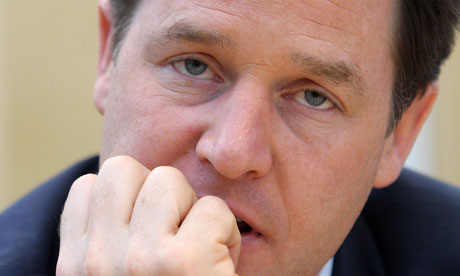
This is intensely difficult for all Liberal Democrat MPs, not least their leader, and the strain showed in his face.  His voice was hoarse with frustration and emotion as the half-hour trial neared its end.
That Labour introduced tuition fees against their own manifesto promise is something that the Government needs to remind people of, and Clegg mentioned this yesterday.  The Labour Party manifesto in 2001 contained the following promise:
"We will not introduce 'top-up' fees and have legislated to prevent them."
This is a point worth reiterating, yet only so far.  It was a long time ago now (most of the students protesting yesterday were still at primary school when that promise was made) and it does not make those photos of smiling Lib-Dem MPs holding NUS pledge placards disappear. There needs to be a better argument made about why the Government's plans for higher education are economically necessary and - I'm going to use two words I can't stand, sorry - fair and progressive.
The Government needs to be incorporating HE policy within its wider education programme, something I wrote about when Lord Browne published his review last month and again following David Willetts' statement to the House of Commons on 2nd November. The universities and skills minister did make the point that the HE reforms sit alongside other education reforms, such as the pupil premium and free schools.  Higher standards of assessment should also be added to that list.  But little has been heard of this line of argument since.  One senior source on the Liberal Democrat benches tells me that the Government needs to put this point across, as better schooling is vital to widening access to higher education.

Martin Horwood - as courageous as he was being the only Lib Dem MP to come out and face the music yesterday afternoon - didn't help the cause by responding to a bolshy student, "do you think the fairies are going to pay for your education?"
The argument that binmen and bricklayers shouldn't be paying their taxes to subsidise the education of university students has run its course.  The considerable value of a highly educated, graduate population is now self-evident, not least in that the UK's economic future lies in expert service industries and high technology.  Moreover, it is estimated that the UK's higher education's economic impact is in excess of £45 billion and the sector supports over 600,000 jobs.
So the Government must make the this argument and it must make it frequently: education is not a zero-sum game and universities are not an isolated part of the education system.   Reforms to higher education do not, on the face of it, appear to be good news but there is plenty of excellent material lying behind the fees increase, such as support for part-time students and reduced repayment costs for many as a result of the increased threshold.  There are many other positive reforms taking place in education as a whole, and the necessary reforms to higher education must be considered as one part of that longer, formative stage in  young people's lives.

Wednesday, 3 November 2010

Mr Willetts was listening - you can't separate universities from schools

The universities and science minister, David Willetts, set out this afternoon before the House of Commons, the Government's final response to Lord Browne's independent review of student finance and funding.  I say "final" with some caution because if there is significant time given over to parliamentary debate and, more importantly, any Commons votes, on the matter, don't bet against it being altered in some ways still.

Nevertheless, we can only go on what we have, for now, and I shan't go into any detail about what the Government's proposals are.  For a comprehensive run-down and commentary, you can do no wrong in having a look at Times Higher Education and Martin at The University Blog.

What I'm very pleased about is that Mr Willetts got up to the despatch box today and presented the Government's higher education policies in a wider, more holisitic education policy framework that takes in the coalition's reforms for schools, from start to finish.

On the date of the Browne Review's publication, 12th October, I wrote an article in which I advised that the Government say:
"We accept Lord Browne's recommendations. Whilst we do so with regret for the extra burden graduates will have to bear, we also do so out of the responsibility to provide a world-class standard of university education for everyone in this country.


However, we cannot only look at universities, nor expect them to resolve the greatest problems of educational underachievement.


Accompanying our Higher Education Bill, to be introduced in 2011, will be a series of detailed measures to encourage greater participation by students from less privileged backgrounds. These measures will complement and reinforce our already radical education reforms, such as increased roll-out of Academies, free schools and the pupil premium."
After PMQs today, David Willetts said, inter alia, the following:
Our higher education system...need[s] for more focus on the student experience, the need to widen access and the need for sustained funding. These challenges led the previous Government, on a cross-party basis, to set up Lord Browne’s review. We are grateful to Lord Browne for his excellent work. I think he has made us all re-examine our positions...


Although participation in higher education has improved in recent years, there has not been enough progress in securing fair access to some of our best-known universities.  We can make progress by improving the school attainment of pupils from disadvantaged backgrounds. That is why the Government are investing in a new premium for two-year-olds, and in the pupil premium. However, we want that focus on improving the life chances of those from disadvantaged backgrounds to continue to university. For that reason, as the Deputy Prime Minister has already announced, we will also establish a new £150 million national scholarships programme, which will be targeted on bright potential students from poor backgrounds to encourage them to apply to university and meet their aspirations.


All universities that want to charge a higher graduate contribution than the £6,000 threshold will be obliged to participate in the national scholarships programme... Our current preference is for universities to offer scholarships to targeted students, including the principal beneficiaries of the pupil premium. That would mean that at least their first year at university was free. Other attractive ideas include expanding the model of a foundation year for young people with high potential but lower qualifications.
This must be the message that the Government repeats, like Labour do so effectively, over and over again.  The reforms to higher education are not isolated reforms - they come as part of a considerably wider education package of immense import.  I believe that it is in doing this that the Government has a chance of winning over Liberal Democrat MPs and the country at large (Paul Goodman put this question earlier on ConHome).

Yet Ministers, blue and yellow, must stick to this task with tremendous conviction.  Although it is considerably less radical than what Lord Browne proposed, it is already hugely unpopular.

Oscar Wilde was stretching hyperbole to the limit when he said "everything popular is wrong".  However, in this case, the unpopular course most certainly is the right one.